Showing posts with label 1940s. Show all posts

Thursday, May 5, 2016

Happy Mother's Day: Mother-Daughter Fashion from the Mid-1940s

With Mother's Day only a few days away, it seems timely to post about that wonderful fashion trend of the 1940s and 1950s, Mother-Daughter fashion! This trend to dress mothers and daughters in matching outfits certainly provided charm for the ladies in the family. In this post, I feature mother-daughter dresses from the mid-1940s that are perfect for spring and summer.


A dirndl skirt in swing length and artfully puffed short sleeves - very nice! Add sash ties or not. The style looks especially cute when contrasting fabrics are used. I rather prefer view 2, myself. :)

Wednesday, April 13, 2016

Beauty in a 7/8th-length Bell Sleeve

The details are similar in these two patterns from the mid-1930s and 1940 - each with  a full sleeved blouse and a bolero that features a 7/8th-length bell sleeve. Yummy fashion!

This lovely ensemble from 1940 features a gorgeous tuxedo blouse that takes advantage of the graceful 7/8th-length bell sleeve to showcase the full sleeves with tucks.


And this ensemble from the mid-1930s has a similar 7/8th-length bell sleeve on the bolero, joined with a full-sleeved blouse that peeks out with charm, showcasing the contrasting fabric.


Marvelous, eye-catching style, don't you think?

Tuesday, March 29, 2016

3 Ways to a Girl's Party Dress

Three dresses, similar looks! Any popular fashion look can be achieved by any number of sewing techniques. The following three patterns (dating from the late 1940s to early 1950s) each feature a similarly-looking dress, but yet each uses a different method to achieve the look, in this case a scalloped yoke and scalloped lantern sleeves.

Hollywood 1616 (view 2, specifically) simply applies trim along the bodice and along the middle of the puff sleeves to produce a faux scalloped yoke and faux scalloped lantern sleeves effect. Cute and easy-peasy to sew!


Mail Order 3856 from The American Weekly magazine actually has a scallop-edged yoke and two-piece lantern sleeves that are joined with a scalloped seam! Seams are joined with a French, or lapped, seam, in case you were wondering! Lace trims the seams of the yoke and sleeves. Very cute! While not difficult to sew, the scalloped seams take a bit more effort.


McCall's 1654 is heirloom-quality and features a button-on guimpe (chemisette) to achieve the effect. The upper bodice and upper sleeves button to the scallop-edged bodice and scallop-edged lower sleeves. Dainty hand-embroidered roses accent the lower bodice and lower sleeves. Exquisite and takes careful sewing!


Now, which dress would you sew?

Tuesday, March 15, 2016

In Search of Style: Finding Inspiration for a 1940s Girl's Dress

The Pattern: This is a classic girl's dress from 1948, with a sweet yoke and short sleeves. It's perfect for every day and for party occasions too!

McCall 7366


The Clippings: Tucked into this pattern, though, were some interesting clippings and hand-made pattern pieces! Both clippings show a great use of contrast fabrics to add a bit of spark.


This second clipping is from an ad for a mail order pattern. Rather than simply order the mail order pattern, though, the sewist chose to use it for inspiration instead, Note the yoke's zig-zag detail.


And also tucked inside the pattern were the hand-made pattern pieces that would create the bodice front! So we know what she sewed. :)


Note the references to the holidays in the newspaper. I wonder if the dress was sewn for Christmas specifically. The ads for cars are interesting - all are for 1940s models, with 1949 the latest model listed!

Monday, February 15, 2016

Scraps from the Past: Playwear in Stripes

The pattern: Simplicity 2444, 1940s

Now is the time we start thinking seriously of summer and great vintage summer fashion. This pattern is the perfect ensemble for a summer day of outdoor play - a picnic, a day in the park or at the beach. The skirt wraps around the step-in playsuit - it's great 40s style!


The scrap: This red-and-white striped piece of fabric was the collar piece, and was tucked in the pattern envelope. This piece of soft cotton looks like it would make a fresh and comfortable ensemble for summer sport and play. Although can you picture the entire outfit in red-and-white stripes? Perhaps this was a contrast fabric piece?


Thursday, January 14, 2016

In Search of Style - Apron Inspirations!

The pattern: Tucked inside this very charming apron pattern, Simplicity 1359, were a couple of large sheets of folded paper. What could they be?


What's inside: What a treasure - it's apron heaven! The sheets of paper (one extra large) were filled with images of hand-drawn aprons! They look like they were most likely traced from mail order pattern offerings in the newspapers. Isn't this a completely delightful and diverse collection? 

A couple of the aprons have the pattern number written next to them, and a few are identified as 1-yd aprons. It would be fun to find all the patterns for these aprons. I love how our mystery sewist focused on the ornamentation details and fabric choices. 


The extra large sheet required two scans to get all the images. There are so many cute aprons illustrated on these sheets, I don't think I could pick just one favorite, I would have to sew a full collection. Wouldn't you? :)


Wednesday, November 25, 2015

Gaylyn's Cute Cat Shorts! And a Happy Thanksgiving to All!

If you were a growing girl, wouldn't you love these shorts with a cat face for the bib? Mail order pattern 120 for suspender shorts is certainly a charmer.


This pattern from the 1940s includes three different cat faces, rendered in applique and embroidery to create the bib. Note the string of daisies that accent two of the three faces. Those must be for the girls. ;) So sweet!


Also included with the pattern were Gaylyn's "measuremints" written on the back of half of a card. A good sewist will always measure before sewing!


When you turn the card over, there is a note to Bertha (our sewist?). Ella Mae McPherson from "the chapter"  (of the local DAR or a similar organization?) has written a very kind and thoughtful get well note to Bertha, sent along with a plant. It appears that this was written before "the holidays" - would that be Christmas? 


The translation for those who are not skilled in cursive handwriting:
"Dear Bertha - 

You may not be able to 
place me but I certainly 
do miss you in the
chapter.
I'm so sorry you are 
ill and hope you will
soon be well again.
I hope this plant will
make your holidays a
little merrier. Sincerely
Ella Mae McPherson"

I love these fragments from people's lives in those days long gone. It is such a personal way to connect with the sewists of other eras.

Happy Thanksgiving to all my readers!

Tuesday, September 29, 2015

1940s Raincoat Is the BEST EVER

Full of fabulous details, this very geeky-nerdy raincoat from Woman's Day magazine and the 1940s absolutely has enchanted me. It appears to be designed for someone who needs all manner of  writing implementss while outdoors in inclement weather. It includes:

  • a pocket for a retractable key holder
  • a pocket holder for pens and pencils (with a chain for one of those!)
  • a holder for 3x5 cards (yes, 3x5 cards!)
  • an invisible pocket for tissues
Pockets are located at the hips, at the waist, and on the arm - isn't that rather remarkable? I also love the attachable hood with visor.


I have marked up this illustration to point out the spiffy details:


On top of all these neato pocket details, the raincoat is lined, the hood attaches to buttons under the coat collar, and the hip and diagonal front pockets are bound. First class!

Thursday, September 24, 2015

In Search of Style & Scraps from the Past: A Dress Sewn from a Sears Catalog Pattern

It's the early 1940s, and where would you shop for a "Superior" pattern for an afternoon dress & bolero, as well as the fabric? Why, the Sears Roebuck catalog, of course! Today's finds were in a pattern from the early 1940s, and included both the catalog page that illustrates the pattern, and scraps of fabric from the resulting sewing project!

First, here is the pattern:


"Shop at Sears for Fashion-Right Fabrics and Patterns"

In Search of Style 

And here is the page from the Sears, Roebuck & Co catalog that was tucked in the pattern:


Note that the ensemble on the model is the very same pattern! And fabric at only 49 cents a yard! Which fabric swatch do you like? I actually like blue print that is on the model, though all the patterns are pretty. :)

Here is a close-up from the pattern instructions. Note the "peek-a-boo" breast pockets on the bolero:


Scraps from the Past

Also inserted in the pattern were these lovely rayon scraps (yes, rayon!). I can so visualize this ensemble in this wonderful floral pattern on a soft taupe-brown.


I'd say it is inspiring fashion from the 1940s and Sears!

Wednesday, June 3, 2015

Scraps from the Past: Sunny Summer Wartime Frock

The pattern: Du Barry 5791 (1944)

I love how the original owner wrote her name on the pattern, and drew an arrow to the version that she sewed. Someone also wrote in very faint pencil vertically next to "This view": "no geathers will bring back" - a somewhat mystifying statement, I can only guess at what was meant. The handwriting is different from the writing in ink, so it may have been someone else.


The scrap: This floral cotton print is just a smidgeon of a scrap that was tucked inside this vintage pattern from the war years. But it is still enough to let us envision this frock in a summery print of blue flowers with pink and green bits. It paints a very pretty and sunny picture!

Tuesday, April 14, 2015

Before and After: Double Duty from a Single Remnant!

It has been a while since I last posted a "Before and After", and this is a marvelous one! My customer Mark McNulty (Irish fashion designer and illustrator extraordinaire!) got great mileage from two patterns and a single remnant of fabric for 4 Euro!

The Pattern: Simplicity 2895 (1940s)


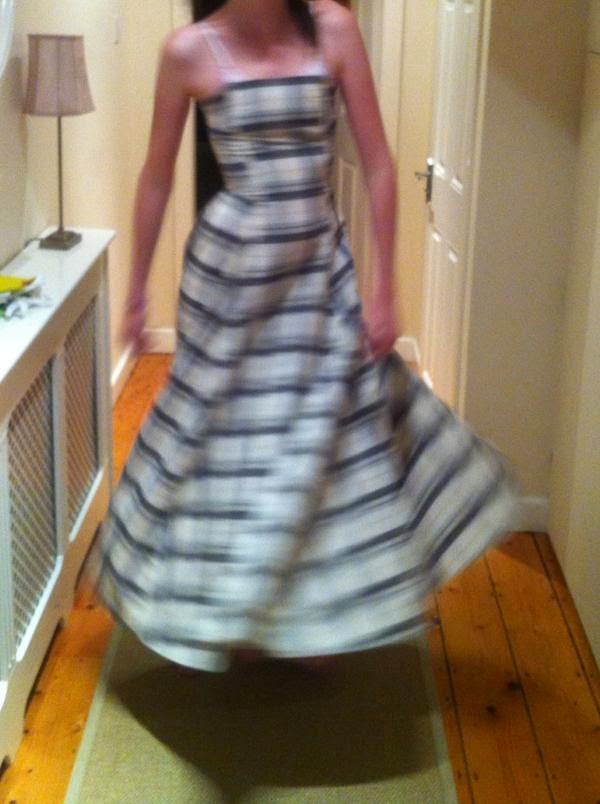
The Results: With this pattern and the fabric remnant, Mark made a beautiful dress for his younger sister. I love it! The swirly, twirly ballerina length is perfect.


It wasn't a perfect fit, though, for his sister, who is 6'1" (and looks like a fashion model, don't you think?). So he took a pattern from the 1960s and was determined to re-purpose the fabric into a jacket! 


The Pattern: McCall's 7593 (1960s)


The Results: He says, "I absolutely fried my brain trying to lay out the pieces of the fabric and trying to get the patterns to match for this sprig little blazer. After a lot of pulling hair, it worked and i even got two cute little bias cut pockets into it too!" I love the lapel pin - adds a dash of class!


Pocket close-up (I think making the pockets bias-cut was totally inspired):


Neat use of hooks-and-eyes make for a slim closing:


Mark, as always, is inspired by fashion. You can see a post about a recent winning illustration of his here. And if you are on Instagram, you can follow him here.

Friday, March 27, 2015

Voices from the Past: Hurry Up, Mother, and Sew This!

A young woman sent a clear message to her mother when she wrote on the back of this lovely, swanky Advance pattern:


You can see her remarks in pencil: "Hurry up with my suit Mother! Hurry, Hurry, Hurry, Hurry". Just a tad anxious, do you think? :) Or was she just practicing her penmanship?


Friday, February 20, 2015

History of Sewing - De-Mystifying Unprinted Patterns

Sewing with unprinted patterns sounds intimidating to many sewists, especially those new to vintage sewing. So to help de-mystify these vintage patterns that have no ink on them, I thought it might be helpful to clarify what is meant by "unprinted" pattern pieces.

First, unprinted does NOT mean completely blank! What unprinted means is that instead of ink, all sewing indicators are marked on each pattern piece with perforations. It is as simple as that! (relatively speaking ;)

Also, unprinted pattern pieces are universally precut. That means there is nothing to cut away (as you do in modern patterns).

Perforations Instead of Printed Indicators


So the key thing to understand when working with unprinted patterns is the meaning of the perforations. The  information that you find on a typical printed pattern indicates:
  • Notches for matching pieces together
  • Placement of a piece on the fold of the fabric 
  • Placement on the straight of grain of the fabric
  • Folds for darts, pleats, tucks, and hemline and position of natural waistline
  • Seam allowance
Now just take each of those printed elements and re-imagine them through the use of perforations on the unprinted pattern piece.

Notches


Notches are the equivalent of diamonds on modern patterns. Match up single notches with single notches and double notches with double notches.

Single notch


Matching Notches


Placement on the Fold of the Fabric


Three circles forming a triangle indicate that this side is to be placed on the fold of the fabric.


However, some pattern makers chose not to use the 3-circle-triangle to indicate placement on the fold. Instead, three (or even two) circles in a row (rather than in a triangle) represents the side to place on the fold of the fabric.


The instructions will clarify which perforations indicate placement on the fold.

I have used red arrows in this image to point out notches and what they match to. Blue lines circle the three circles that form a triangle and indicate to place that side on the fold of the fabric.


Two circles here represent the placement on the fabric fold (blue circles):


Placement on the Straight of Grain


Pairs of one, two or three circles  (usually large circles, but not always) in a row along the center length of the piece indicate the straight of grain (or straight of goods) for the piece. The placement on the straight of grain is always defined in the instructions.


Another example of single circles in a row that indicate the straight of grain:


To indicate the straight of grain, this pattern uses three sets of three small circles in a row for pieces 3 and 6, while two sets of three small circles suffice for pieces 4 and 1. Pieces 2, 5, and 7 don't need the straight of grain indicated because they are placed on the fold, as indicated by the triangle of circles on one side


You'll notice in these examples that patterns vary in how detailed they explain the meanings of the perforations in the illustrated list of pattern pieces. In all cases, though, the sewing instructions are very clear.

Darts, Pleats, Tucks and More


These various perforations are used to indicate different things, depending on the manufacturer. They are typically explained in the pattern's instructions.


  • Folds for darts
  • Folds for pleats or tucks
  • Natural waistline
  • Placement of buttonholes
Perforations for a dart form a triangle that looks like a dart and is placed where you expect it.

Folds for pleats or tucks are parallel rows of circles, sometimes the same size, sometimes alternating rows of large and small circles. To form the pleat or tuck, you fold the fabric so that one row of circles aligns with the next row.

The natural waistline is often indicated in dresses or blouses that extend below the waistline. This allows you to adjust the pattern as needed so that it fits properly for your waistline.

Placement of buttonholes are also indicated with perforations, usually pairs of small circles.

Hemlines


Sometimes hemlines are "allowed" for in the pattern pieces, but sometimes they are not! Especially with wartime unprinted patterns (in the 1940s when paper was at a premium), it was not unusual for the pattern pieces to omit an hemline allowance altogether. So be sure to read the instructions to determine whether the pattern pieces do or do not include a hem allowance. If they do not, you will have to extend the pattern at the hemline end for the length of hem that you would like.

Seam Allowance


Most pattern companies are content with simply stating the seam allowance on the instruction sheet. Occasionally (I have only seen this with unprinted Vogue and Hollywood patterns) a series of small circles around the outer edge of each pattern piece represents the seam allowance. And unless the pattern states otherwise, the seam allowance is designed into each pattern piece. This means you do not have to add any seam allowance when cutting each pattern piece.


Especially in unprinted, precut patterns, the seam allowance is not standardized. Sometimes the pattern instructions will state that all seam allowances are 1/2 inch. Or that the seam allowance is 3/4 inch at underarms and 1/2 inch on all other edges. So always be sure to check the instruction sheet thoroughly for the seam allowance.


Here is what the pattern piece would look like with perforations for seam allowance.


Here is how it would appear for the entire pattern:


Another example:


Well, that's it for now! I am sure that no matter how long I have labored with this post (off and on for a very long time), as soon as I post it, I will think of things I forgot to mention, Well, that will be material for a follow-up post!

Hopefully you now feel armed to sew with vintage unprinted patterns, whether or not you have previously sewn with modern patterns. Just be sure to read the instructions thoroughly before you begin! And I am happy to answer questions. :)