Sunday, November 25, 2012

Cyber Monday Sale Blitz!

Wheeeee, it's time for a shopping spree! Who doesn't love a sale? My shop,  Midvale Cottage, as a member of the Etsy Pattern Patter Team, is participating in the team's Cyber Monday sale starting midnight tonight! I'm offering a discount of 20% off your entire order! Just use the coupon code: CMBLITZ. My sale will be running to the end of Friday, November 30th.

Be sure to visit the team's many wonderful shops for discounts in vintage sewing patterns, as well as fabric, sewing notions and fabulous fashions. Check out the team's blog for a list of participating Etsy shops. Note that different shops may have different coupon codes and discounts.

You can find Pattern Patter sellers here: Pattern Patter Team Members 

Here is a sneak preview of some new items coming to my shop this week:


Sunday, November 18, 2012

Scraps from the Past: 1960s A-line Sheath in Dainty Cotton Print

This 1968 A-line sheath with empire waistline is so charming - a popular style that flattered every figure. :)


Tucked inside was this bias strip of deep navy blue and tiny white floral print cotton:
The original seamstress sewed view A (on the far left) - can you picture it? It looks like summer to me. :)

Monday, November 12, 2012

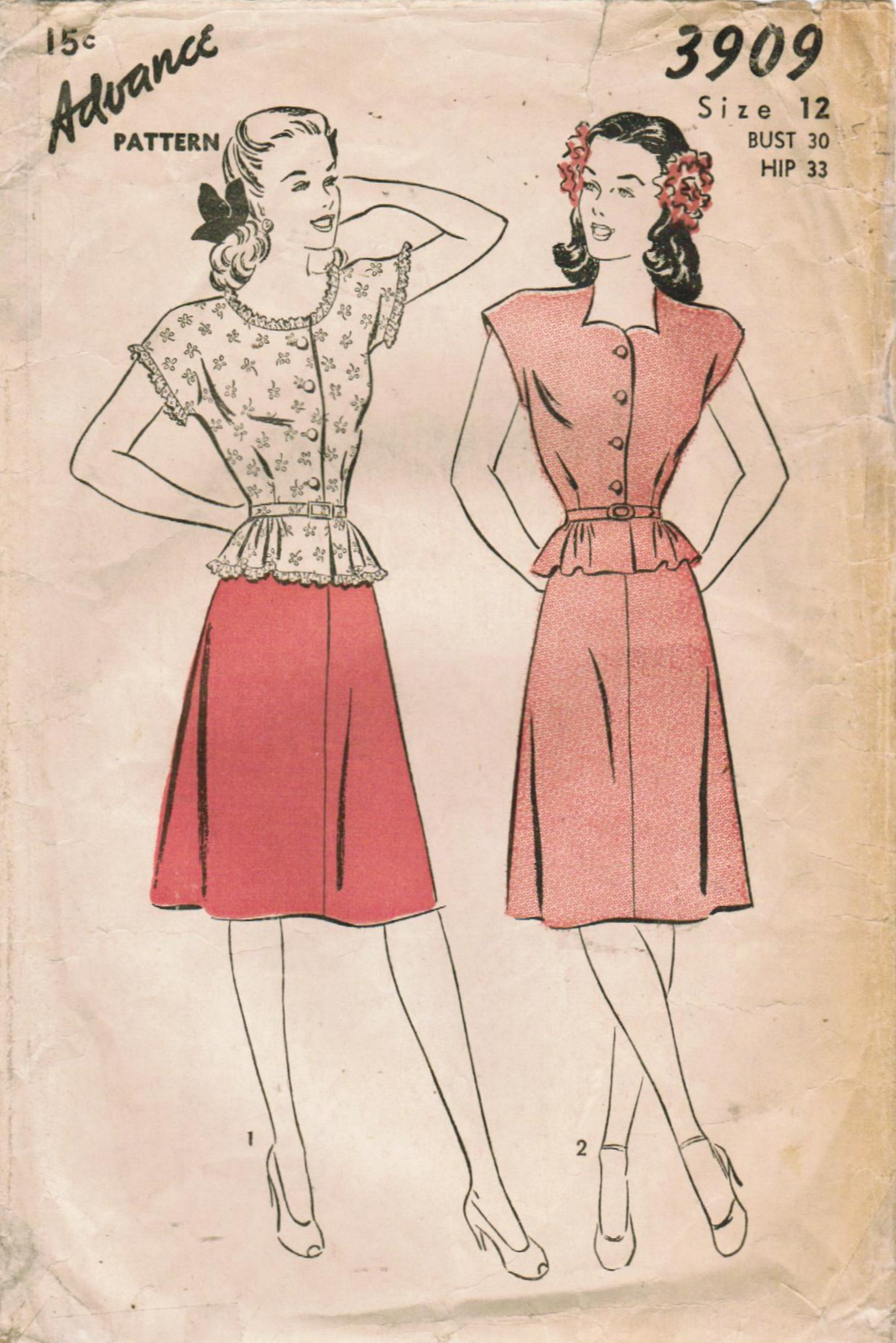
In Search of Style: 1940s Blouse with Peplum Charm!

Tucked in a pattern from the war years was this clipping of a very happy model wearing a beautiful formal blouse with a pert gathered peplum:


Here is the pattern, Advance 3909 from 1943, with models looking equally happy in blouse with peplum and flared swing skirt.


Let's compare! Both blouses have:
  • lightly fitted bodice
  • cap sleeves
  • shaped neckline
  • gathered peplum
  • self-fabric belt
The neckline is not identical, and the pattern has a front buttoned closing, otherwise, nice match! Don't you think? :D

Thursday, November 8, 2012

Buying vintage patterns online - Midvale Cottage is a favorite!

Midvale Cottage a favorite? It's not my own opinion! :D

Imagine my surprise and delight when I was contacted the other day by Vanessa of VanessaLovesVintage on Etsy, who wrote a blog post on buying vintage patterns online - the good and the bad. :) Thank you, Vanessa!

Happily, she listed my Etsy shop, Midvale Cottage, in her list of favourite sellers. I am so thrilled to receive such a public endorsement. Coming from a buyer of many vintage patterns, this is really an honor.

I do try very hard to ship patterns in as best a condition that is possible. I am methodical and meticulous in my processes, to the extent that any person can be. I do all the things she mentions - the careful counting, noting the condition of the pieces, repairing with archival mending tissue. I ship with care too - always in an archival plastic sleeve and stiff cardboard for protection. If a pattern is especially fragile, I will add bubble wrap. If the destination is especially soggy (there are some in Australia!), I can ship in a plastic envelope rather than paper.

And on those rare occasions when I do goof up (not too many in my 4 years on Etsy, thank heavens), I bend over backwards to correct my mistake so the customer does not suffer. :)

If you ever have any suggestions on how I can improve my customer service, please feel free to pass them on to me. And be sure to visit Vanessa's Etsy shop and her Twinkle Sparkle Shine blog for vintage sewing and crafts inspiration!

Saturday, November 3, 2012

History of Sewing - 1950s Vintage Pattern Sizes and Body Types

1950s Pattern Sizing

In this, my third post on vintage pattern sizing, it's time to examine the 1950s. The decade starts out looking much like the 1940s, but in the middle of the decade, things will change!

In the early and mid 1950s, pattern sizes remain consistent with sizes in the late 1940s. Categories remain the same: Women (or Ladies), Miss, Junior (or Junior Miss), Teens, Girls, Children, Infants, Boys, Men. And sizes remain the same for these categories. The Half-Size is still a relatively "new thing" but makes gains during this decade.

Misses and women's sizes run in even sizes from 10 to 46, and a size 16 is still a bust 34, waist 28, hip 37. Teen and junior sizes run in odd sizes, from 9 through 19. The junior figure is defined as a shorter-waisted figure than the miss, as well as slighter in other respects.

Pattern sizes from McCall's Complete Book of Dressmaking 1951


 An early 1950s Junior pattern from McCall's


A Note about the Half Size


The junior figure is not to be confused with the half size figure. Half sizes are defined as figures that are shorter than regular size figures, and are usually slightly larger at the waistline and hip line. Half-size gals had the option to either buy a half-size pattern or purchase a regular pattern and alter it, using the directions in the following image.


Sizes Change in the Mid 1950s!

In the mid-to-late 1950s pattern sizes begin to change, apparently in response to size changes issued by the US Bureau of Standards. I have read various sources on the Internet that place the date of this change variously in 1957 or 1958, but when I view the patterns themselves (and their copyright dates), I see the change starting to occur as early as 1955 and definitely implemented by 1957. Regardless of the precise date, the effect of the change has hips at only 2 inches (5cm) larger than the bust. Bust 34 is now a size 14 instead of size 16. The waist drops 2 inches and the hips shrink one inch. Here is a comparison:


 1930s-1955 1955+
Size 16
Size 14
Bust 34
Bust 34
Waist 28
Waist 26 
Hip 37 
Hip 36

Body Types

From Vogue Sewing Book 1958, you can see the familiar body types that we know from the 1940s: Junior Miss, Teen, Miss, and Women:


The Vogue Sewing Book 1958, like sewing books of all eras, provides instructions on how to measure yourself.

 Pattern Sizes

But now note the new sizing!


Wednesday, October 24, 2012

Keeping Warm in Great Style with Vintage Coats

As winter approaches here in the Northern Hemisphere, my thoughts turn to overcoats and especially the beauty of vintage coats. Some of my favorite styles are from the 1940s and 1950s. Wonderful tailored details make me simply drool. :D  Swing backs, trapeze silhouettes, deep cuffs, chic collar treatments, and more - enjoy this review of coats, long and short, for women and girls, from the 1940s and 1950s.

Misses 1940s


Girls 1940s


Misses 1950s


Girls 1950s


Tuesday, October 9, 2012

Vintage Style Trends: Detachable Collars and Cuffs

Detachable collars and cuffs were so popular in the last century (it feels weird to write about it that way), beginning in the 1940s but particularly popular in the 1950s, and lasting through the 60s and 70s and beyond. Detachable collars and cuffs were a mainstay of the wardrobe. The advantages, aside from adding striking color accent, were extension of a small wardrobe by adding variety, and reduction in cleaning costs and effort. The notched and wing varieties of collar and cuffs were extremely popular.

There are 3 variations of the detachable collar and cuffs:
  • Over-collar and over-cuffs added to garment with single collar and cuffs
  • Under-collar and under-cuffs added to garment with single collar and cuffs
  • Collar and cuffs added to collarless and cuff-less garment

The Technique

The technique used for detachable collars and cuffs was to edge the collar or cuff with bias binding. That bound edge was then attached to the garment by simply whip-stitching in place. It is that simple. No snaps, no buttons, no hooks-and-eyes. It is a  rather uncomplicated, simple method, it seems to me!

Here are a couple of examples of detachable collars & cuffs from magazine advertisements of the 1950s:


The following patterns illustrate the over-collar and over-cuffs added to garment with single collar and cuffs:


The following pattern illustrates the less common method of under-collar and under-cuffs added to garment with single collar and cuffs:


The following patterns illustrate the collar and cuffs added to a collarless and cuff-less garment:


A popular item in the 1950s was the "accessory dress", which was purposefully collarless and cuff-less. The sewing pattern provided several styles of collars and cuffs with which to "change up" your look. Here is a great example: