Showing posts with label pattern sizing. Show all posts

Thursday, February 14, 2013

History of Sewing - 1960s Vintage Pattern Sizes and Body Types

 At the end of the 1950s, seamstresses hopefully had adjusted to the "new sizing" changes that occurred in the mid-late 1950s. But in the 1960s, more changes are afoot. New figure types will be added (junior petite and chubbie girls), some figure types will be merged (sub-teen or pre-teen and teen become young junior/teen), and at the end of 1967 another complete sizing shift will occur.


Revisiting the End of the 1950s

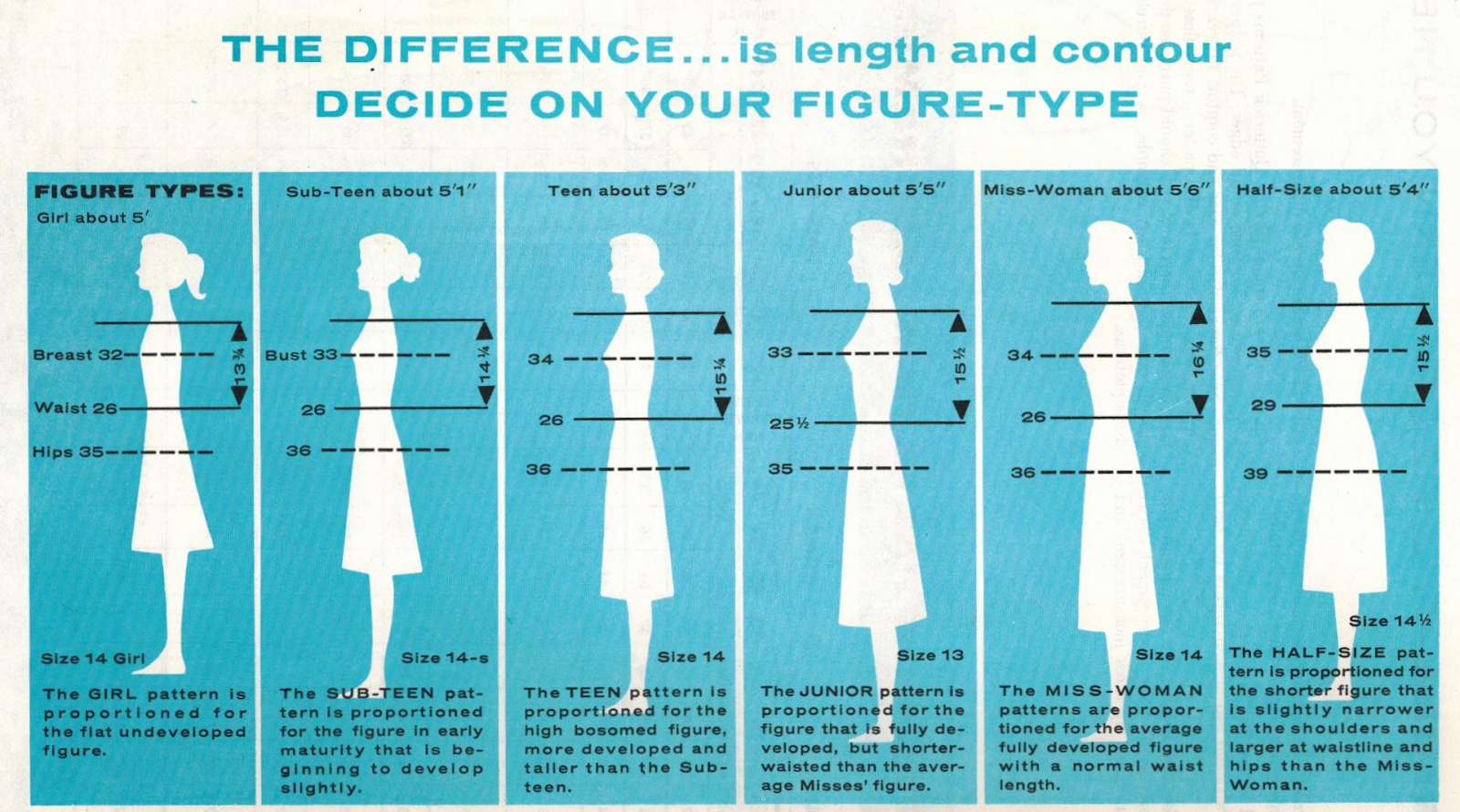
To refresh your memory (if you don't want to review my post on 1950s pattern sizes),  here are pattern sizes from a 1959 Butterick Sewing Book. Note that there are separate pattern sizes for sub-teen, teen, junior, miss, woman, and half sizes. Note also that the Junior figure type IS considered a fully-developed (or mature) figure type, not a youthful (that is, teen-like) size. The Junior figure is simply relatively higher-busted and shorter-waisted than the Miss figure type (and maybe a tad shorter).


 Early and Mid 1960s

Although sizing from the end of the 1950s through the mid-1960s remains consistent, note that the sizes are NOT consistent from one pattern maker to another. Compare the Butterick sizes above, with those from Vogue (Vogue Sewing Book dated 1964) (Note that the "New Sizing" referred to here are the size changes from the late 1950s.):


McCall's Easy Sewing book from 1964 provides sizes and figure types similar to those of Butterick, but replaces Sub-Teen with Pre-Teen, and adds the Junior Petite figure type:


And in 1966, McCall's sizes are still the same. This McCall's Step-by-Step Sewing Book provides a nice comparison of the Misses figure type with each other type.


1967 - Time to Change to New Sizes!

In late 1967 sizes change yet again!!! Effective November 1, 1967, pattern companies made the shift to new sizes developed and approved by the Measurement Standard Committee of the Pattern Fashion Industry. The pattern sizing change was made to correspond more closely with standard ready-to-wear sizing (at that time). Was access to better or more food a factor in the size changes of the late 50s and this change in the late 1960s? A good topic for research and discussion!

The sizes affected Misses, Women's, Half-Size, Junior, and Junior Petite. Teen and Pre-Teen sizes were replaced with a new size range - Young Junior/Teen.

Sizes essentially shifted downwards. For example, for the Misses figure type with bust 34, the size changed from 14 to 12. The ratio of hip to bust remains the same (bust 34, hip 36), but the waistline is reduced by a half inch (a full inch for some sizes): Before: bust 34, waist 26, hip 36 - After: bust 34, waist 25-1/2, hip 36.

McCall's Step-by-Step Sewing Book from 1968 does a great job providing a comparison of the former sizing with the new:


And here are the "new sizes" as published in a Simplicity Sewing Book from 1968, which includes a  "Chubbie" figure type for girls: 


Saturday, November 3, 2012

History of Sewing - 1950s Vintage Pattern Sizes and Body Types

1950s Pattern Sizing

In this, my third post on vintage pattern sizing, it's time to examine the 1950s. The decade starts out looking much like the 1940s, but in the middle of the decade, things will change!

In the early and mid 1950s, pattern sizes remain consistent with sizes in the late 1940s. Categories remain the same: Women (or Ladies), Miss, Junior (or Junior Miss), Teens, Girls, Children, Infants, Boys, Men. And sizes remain the same for these categories. The Half-Size is still a relatively "new thing" but makes gains during this decade.

Misses and women's sizes run in even sizes from 10 to 46, and a size 16 is still a bust 34, waist 28, hip 37. Teen and junior sizes run in odd sizes, from 9 through 19. The junior figure is defined as a shorter-waisted figure than the miss, as well as slighter in other respects.

Pattern sizes from McCall's Complete Book of Dressmaking 1951


 An early 1950s Junior pattern from McCall's


A Note about the Half Size


The junior figure is not to be confused with the half size figure. Half sizes are defined as figures that are shorter than regular size figures, and are usually slightly larger at the waistline and hip line. Half-size gals had the option to either buy a half-size pattern or purchase a regular pattern and alter it, using the directions in the following image.


Sizes Change in the Mid 1950s!

In the mid-to-late 1950s pattern sizes begin to change, apparently in response to size changes issued by the US Bureau of Standards. I have read various sources on the Internet that place the date of this change variously in 1957 or 1958, but when I view the patterns themselves (and their copyright dates), I see the change starting to occur as early as 1955 and definitely implemented by 1957. Regardless of the precise date, the effect of the change has hips at only 2 inches (5cm) larger than the bust. Bust 34 is now a size 14 instead of size 16. The waist drops 2 inches and the hips shrink one inch. Here is a comparison:


 1930s-1955 1955+
Size 16
Size 14
Bust 34
Bust 34
Waist 28
Waist 26 
Hip 37 
Hip 36

Body Types

From Vogue Sewing Book 1958, you can see the familiar body types that we know from the 1940s: Junior Miss, Teen, Miss, and Women:


The Vogue Sewing Book 1958, like sewing books of all eras, provides instructions on how to measure yourself.

 Pattern Sizes

But now note the new sizing!


Thursday, October 4, 2012

History of Sewing - 1940s Vintage Pattern Sizes and Body Types

1940s Pattern Sizing

In the early 1940s, not much has changed from the 1930s in pattern sizing, aside from dropping the reference to "years". Categories remain the same: Women, Miss, Junior or Junior Miss, Girls, Children, Infants, Boys, Men. However, we begin to see the Junior Miss with odd numbers for sizes, while Miss sizes are even numbers. But as the decade progresses, pattern manufacturers begin to pay attention to figure types. This will result in some fine tuning of sizes, as described below.

This summary of body sizes is from the Butterick Sewing and Dressmaking book from 1944.


The 1944 Butterick Sewing and Dressmaking book provides these descriptions of different body types: Full, Tall Angular, Short Full, Junior Miss, Miss, and Average. While at this point, pattern sizes don't address the tall angular or the short full figures, it points the way to the half size patterns that begin to appear later in the 1940s and the future "proportioned" patterns that will appear in the 1950s. It also points out that the Junior Miss is a type not an age - an important distinction.


Sizes in a 1948 Vogue book on sewing are similar to the sizes described in the Butterick book, but shortens Junior Misses to Juniors.


A Simplicity sewing booklet from 1949 adds Teen and Half Sizes to the list of body types, and actually provides more detail to explain the differences. This is the first time we see the Half Size, which is a great addition that addresses the needs of women with a shorter than average body type.


Note how Woman's sizes are essentially identical to Misses, but simply extend to higher sizes and provide both youthful and "mature" (also referred to as "matronly", meaning older than "Miss") designs.


Pattern manufacturers continue to produce their patterns in compliance with government-defined standards (extremely important during World War II), but the addition of body types is a great acknowledgement that we all aren't "average". The  beginning of producing pattern sizes that address those different body types is a boon to seamstresses in reducing the amount of work to adjust a pattern to fit.

I hope this information helps those of you sewing 1940s vintage patterns. Just keep the proportions in mind as you purchase and sew patterns from this decade. And knowing the differences can allow you to purchase a pattern in a size type that you might not normally purchase for yourself (Teen or Junior Miss for example), with an expectation of how you can alter it to fit.

Happy sewing!

Thursday, June 14, 2012

History of Sewing - 1920s & 1930s Vintage Pattern Sizes and Body Types

1920s and 1930s Pattern Sizing

Do you find the differences in vintage pattern sizes just a tad confusing? I decided that de-mystifying the changes to pattern sizes over the decades would make a great project. So beginning with this post, you will see the results of my explorations. I'll start with the 1920s and 1930s, and then move forward in time in future posts. Let the journey begin!


In the 1920s and 1930s, pattern sizes and body types were defined simply by sex and age:  infants, children, boys, girls, men, juniors, misses (or ladies), and women.
Misses sizes in "years"
One of the first things I noticed and found interesting in pattern sizes for misses or ladies from the 20s and 30s were that sizes were often referred to simply as "years". This was a natural extension of sizes for children based on the average size by age. The upper limit of girls' sizes was 14 years (breast 32), while sizes for misses or ladies commonly began at 12 years (bust 30). Eventually the word "years" was dropped, and that is how we have come to use the numbers we use for sizing today (size 10, 12, 14, and so on).  The use of odd numbers started in the 1920s and at first were not necessarily associated with junior sizes.

An early 1930s ladies' mail order frock for size 20 Years


A youthful 1920s pattern for "12 Year Size"


1930s Butterick pattern with even and odd numbers for misses and women's sizes


 1930s  mail order pattern for junior sizes with odd numbers


 Women's sizes simply go for "bust"
Sizes for women with a "mature" or "matronly" figure were simply sized by bust measurements and ranged from bust 34 up to to bust 48. This method has persisted through the decades, although in the 1920s and 1930s the bust measurement IS the size.

A 1920s women's Elite Styles blouse pattern "Bust 34"


An early 1930s women's Excella frock pattern Size 36


What, no waist?
While 1920s fashions had little to no definition at the waist for ladies' clothing, 1930s fashions brought the waistline back. Nonetheless, for both decades, unless they were for skirts, patterns commonly (though not always) list just the bust and hips, omitting the waist size. Now why would they do that?

One aspect was that the selection of a dress pattern was based on the size of the bust or the hips, whichever was more appropriate for fit. Another aspect was that women were skilled in sewing and simply expected to alter the pattern to fit, which made listing the waistline rather moot. Sewing books of the era provide extensive guidelines on how to alter patterns to ensure a perfect fit, covering every conceivable type of fitting problem.  Butterick patterns in the 1920s and 1930s even had the special feature of "Let-Out Seams", an extra seam allowance at the hips to ease alterations.

Typical 1930s pattern with Misses' sizes listed as "years" and no waist measurement


 Women's Anne Adams pattern with no waist measurements


Proportions
As a general rule, when a new design was created by a pattern manufacturer, it was first created for size 16. Other sizes were then graded up and down through the range of measurements from the master pattern. Measurements were fairly (though not always) consistent through the 1920s and 1930s. For example, most frequently size 16 meant Bust 34 inches, Waist 28 inches, Hips 37 inches. Watch this bust-to-waist-to-hips ratio, as it will change over time. In general, a larger waist and larger hips were defined for a given bust size in the 20s and 30s, than was defined in later decades.

1930s Simplicity pattern listing body measurements for "years"

 
In the end, it's all about fit

The importance of being measured before you buy a pattern was a maxim for the seamstress, then as now. "New corsets or a change of diet may have altered your bust, waist, or hip measure."  a sewing book from 1927 states in its comments on taking body measurements. That same sewing book states, "Put on your best corsets and a dress that fits nicely" before taking your measurements. Another sewing book from the early 1930s states that to measure your waistline, "tie a tape around the figure at a becoming waist line". :)

Whether you are sewing vintage patterns from the 1920s, 1930s, or later, always measure yourself (corset not required ;)) and always carefully compare those measurements with the stated measurements on the pattern. And then use your preferred method to determine any adjustments in length or proportion that are necessary. Careful attention to size and fit will ensure that your fashions from the 1920s and 1930s are, indeed, fabulous!

I hope you have enjoyed this exploration of vintage pattern sizing in the 1920s and 1930s, and found it informative. Be watching for my next installment in this series, the pattern sizing of the 1940s!